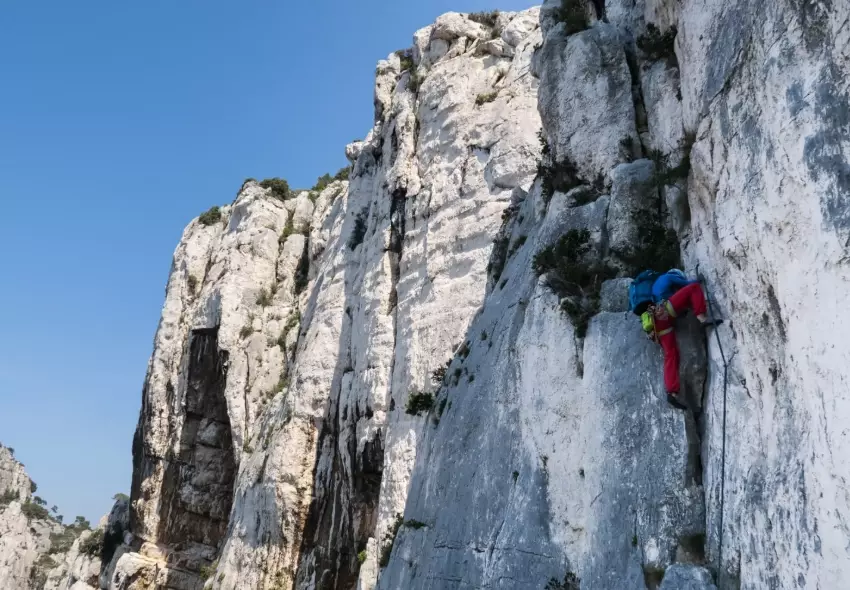
Ask ten climbers "what is a climbing route?" and you'll get ten different answers. For the newbie, it's just a line on a rock. For the guidebook author, it's a named sequence of moves with a history. For me, after fifteen years of scraping my knuckles on granite and limestone, a route is a conversation. It's a problem posed by the rock, and your body and mind have to figure out the solution. This guide will move past the textbook definition and into the real-world details that actually matter when you're planning your next climb.
Your Quick Route Map
- More Than Just a Line on Rock: A Practical Definition
- The Five Main Types of Climbing Routes (And Where to Find Them)
- How Are Climbing Routes Graded? Decoding the Numbers
- How to Read a Climbing Guidebook: A Step-by-Step Decoder
- A Real-World Example: Planning Your First Outdoor Sport Climb
- Your Climbing Route Questions, Answered
More Than Just a Line on Rock: A Practical Definition
At its most basic, a climbing route is a defined path up a rock face, ice wall, or artificial structure. But that's like calling a symphony a bunch of notes. The magic is in the specifics.
A route has a start point and a finish point (the summit or anchor). Between them lies a sequence of holds, cracks, and features you use to ascend. It's given a name (sometimes poetic, often silly), a difficulty grade, and is documented in a guidebook or on a site like Mountain Project. The first ascensionist who climbed it without aid gets to name it and propose the initial grade.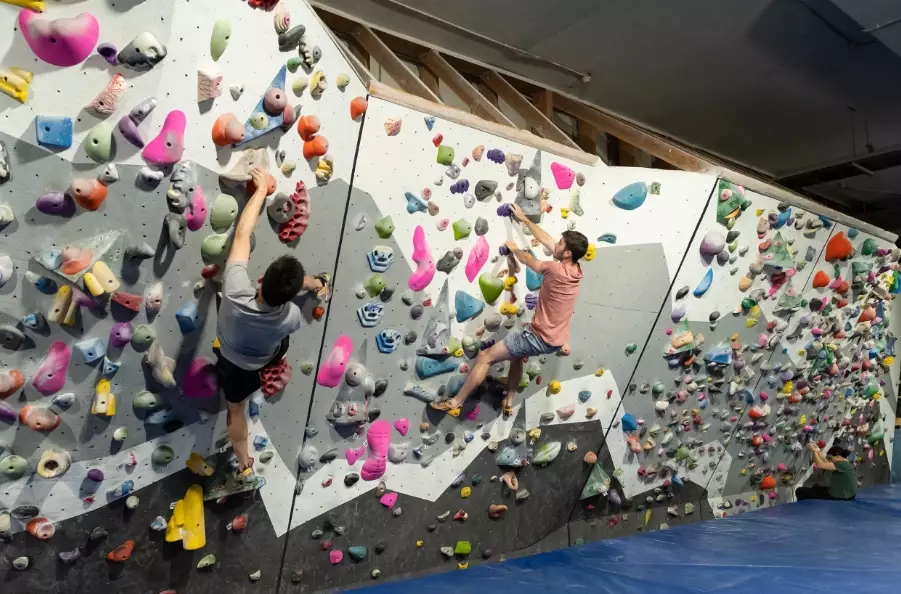
The Five Main Types of Climbing Routes (And Where to Find Them)
You can't talk about routes without knowing the game you're playing. The type dictates the gear, skills, and mindset you need.
| Route Type | Key Characteristic | Typical Gear Needed | Best For Beginners? | Classic U.S. Destination |
|---|---|---|---|---|
| Bouldering | Short, powerful climbs (under 20 ft) without ropes. Focus on hard individual moves. | Climbing shoes, chalk bag, crash pad. | Yes. Low commitment, great for building strength and technique. You can start at a gym. | Hueco Tanks, TX; Bishop, CA. |
| Sport Climbing | Permanent bolts are pre-placed in the rock for protection. Focus on continuous movement. | Harness, rope, quickdraws (10-15), helmet, belay device. | Best first outdoor step. Lets you focus on climbing while the bolts manage safety. | Red River Gorge, KY; Smith Rock, OR. |
| Trad (Traditional) Climbing | You place and remove all removable gear (cams, nuts) into cracks and features for protection. | Full rack of cams/nuts, harness, rope, helmet, slings. | No. Requires extensive gear placement and risk assessment training. Find a mentor or take a course. | Yosemite Valley, CA; Indian Creek, UT. |
| Top-Roping | The rope is already anchored at the top of the climb. The climber is protected from above. | Harness, rope (if not fixed), helmet, belay device. | Absolutely. The safest way to learn. Often set up at beginner crags. | Any local crag with easy access to the top. |
| Big Wall / Multi-Pitch | Routes so long they require multiple rope lengths (pitches). You stop at ledges to belay. | Trad or sport gear, plus haul bags, portaledge for multi-day walls. | Advanced only. Requires speed, efficiency, and systems management far beyond single-pitch climbing. | El Capitan (Yosemite); The Diamond on Longs Peak, CO. |
I made the mistake of jumping on a "moderate" trad route as my second-ever outdoor climb because the grade looked easy. The grade was for the moves, not the terrifying run-outs between sketchy gear placements. I learned more about fear management in that hour than in a year at the gym. Start with sport or top-roping.
How Are Climbing Routes Graded? Decoding the Numbers
Grading systems try to standardize difficulty, but they're famously subjective. A 5.10 in slippery Gunks quartzite feels different from a 5.10 on featured Tuolumne Meadows granite.
The Yosemite Decimal System (YDS) for Roped Climbing
This is the main system in the US for most roped climbing. It looks like this: 5.4, 5.7, 5.10a, 5.12d.
The "5" refers to the class (5th class means technical rock climbing). The number after the decimal indicates difficulty. Below 5.10, it's just a number (5.4, 5.5, 5.6...). At 5.10 and above, letters are added (a, b, c, d) for finer gradation, with "a" being easiest and "d" hardest.
Beginner Range: 5.4 - 5.7
Intermediate: 5.8 - 5.10
Advanced: 5.11 and up
The V-Scale for Bouldering
Bouldering uses the "V" scale, from V0 (easiest) upwards. There's also a "VB" for beginner problems easier than V0. The scale is open-ended; as of now, the hardest are around V17.
Here's the non-consensus take everyone forgets: The number is not the truth. It's an opinion, often from the first ascensionist who was exceptionally strong in a specific style. A sandbagged route is graded easier than it feels. A soft route is graded harder. Grades also get easier over time as techniques and shoes improve. Use the grade as a rough guide, not a gospel. Check the guidebook comments or Mountain Project for the consensus.
How to Read a Climbing Guidebook: A Step-by-Step Decoder
A guidebook is your bible. Cracking its code is essential. Let's dissect a typical entry for a sport climb at the Red River Gorge, inspired by a classic like "Roadside Attraction."
1. Route Name & Grade: "Roadside Attraction, 5.8". Straightforward.
2. Star Rating (★): This denotes quality and how "classic" the route is. ★★ is solid. ★★★ is a must-do classic. ★★★★ is life-changing. No stars might mean it's dirty, mossy, or just not great. I often choose routes based more on stars than grade.
3. Protection Code: This is critical. "Sport, 12 bolts to 2-bolt anchor." Tells you it's bolted, how many quickdraws you need (12), and what's at the top. A trad route might say "Trad, gear to 3".
4. Route Description: "Start on the obvious ledge 15 feet right of the oak tree. Climb the sustained face on good edges and pockets past a small roof at bolt 6. The crux is moving past bolt 9 to a welcome jug." This is the beta—clues about the sequence. Some climbers prefer to figure it out themselves (onsight).
5. Route Diagram (Topo): A small drawing showing the line, bolt locations (Xs or dots), anchors (a circle with an X), and any key features like a roof or crack. Match this to the cliff face.
Always cross-reference with a current online source like Mountain Project for recent condition updates. Guidebooks can be years out of date. A route that was 5.10a five years ago might have lost a key hold and now feel like 5.10c.
A Real-World Example: Planning Your First Outdoor Sport Climb
Let's make this concrete. Say you're a gym climber solid on 5.10s, planning your first trip to a real crag. Here's how you'd use all this info.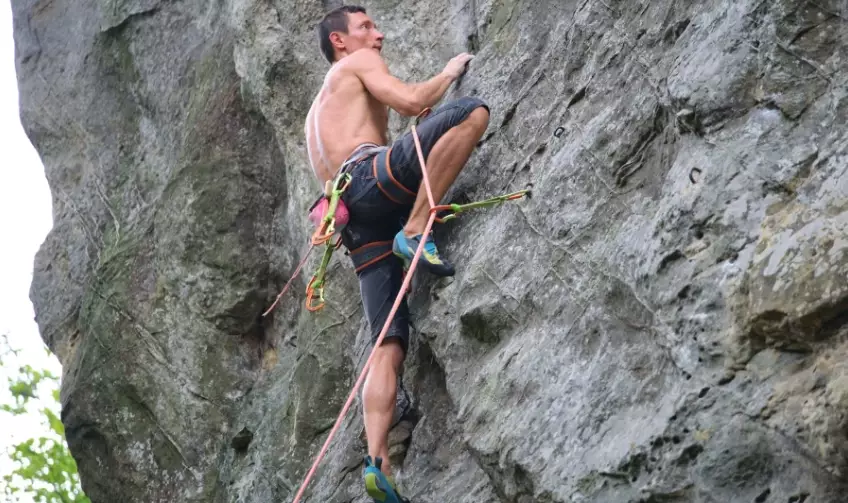
You pick a known beginner-friendly area. Muir Valley in the Red River Gorge is perfect. You get the guidebook or pull up Mountain Project on your phone.
Your filters: Sport climbs, grades 5.6 to 5.9, 3-star quality. You're looking for a high-quality, fun experience, not a sandbagged sandpaper nightmare.
You find "Practice Wall"—a cluster of 5.7s and 5.8s. The description says "short approach, well-bolted, great for beginners." Perfect. You note you need a 60m rope and about 10 quickdraws.
You drive there, hike the 10-minute trail, and spot the wall using the guidebook photo. You match the topo to the rock. You see the first bolt of your chosen route, "Beginner's Luck, 5.7." You rack your draws on your harness, tie in, and your partner checks you. The conversation with the rock begins.
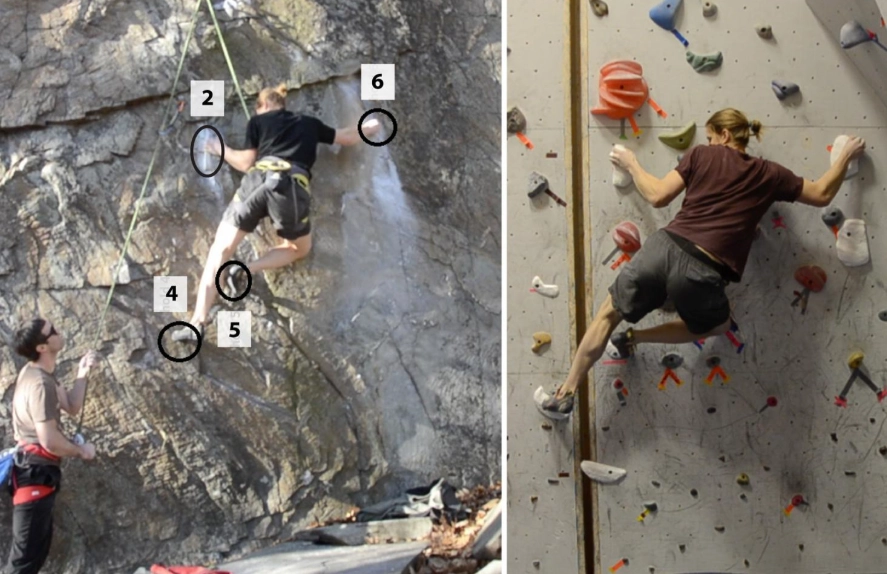
The holds feel different—grittier, more subtle. You have to look for them instead of seeing brightly colored plastic. You clip bolt 3, feeling the exposure. You solve the little puzzle at the small overlap, just like the book said. You pull over the top, clip the anchors, and look out at the valley. That feeling—that's what a route is.
Your Climbing Route Questions, Answered
How do I choose my first outdoor climbing route?
Ignore the hardest grade you can climb in the gym. Subtract at least two full number grades. If you gym-climb 5.10, look for 5.7 or 5.8 outdoors. Prioritize routes described as "well-protected," "good for beginners," or "classic." The goal is a positive experience, not ego. Go with someone more experienced if possible.
What's the biggest mistake beginners make when reading grades?
They assume the grade is an absolute measure of physical difficulty. It's not. It heavily reflects the style of climbing. A vertical face climb with tiny edges (technical) and an overhanging jug haul (powerful) can both be 5.10. Know your strength. If you're powerful but lack technique, a technical 5.10 will feel impossible. Read the description for words like "technical," "crimpy," "jugs," or "powerful."
 Are guidebooks becoming obsolete with apps like Mountain Project?
Not even close. Apps are great for up-to-date condition reports and finding routes. But a good guidebook provides crucial context: the history of the area, detailed approach maps that don't require cell service, and curated selections. The author's opinions on quality matter. I use Mountain Project for beta and recent photos, but I always buy the local guidebook to support the developers and authors who maintain the area. They're the ones bolting replacements and building sustainable trails, often through organizations like the Access Fund.
What does "sandbagged" really mean for a climber?
It means the route feels significantly harder than its posted grade. This often happens on older routes, established by legends in their prime, or in areas with a proud, stiff grading ethic (like the Gunks or parts of Colorado). It's a mental game. If you hop on a classic 5.9 that feels like a desperate 5.10+, you've probably found a sandbag. Don't let it crush your ego—it's a rite of passage. Laugh about it, and know that sending a sandbagged classic earns you extra respect.
 How important is the "star rating" compared to the grade?
On a leisure climbing day, I prioritize stars over grade. A 3-star 5.8 will almost always be more fun, memorable, and well-featured than a 1-star 5.10. The stars indicate the quality of the rock, the movement, and the overall position. Climbing is about enjoyment, not just ticking numbers. Chasing stars is a fantastic way to find the best climbs an area has to offer at your comfort level.